Imagine knowing exactly which leads are ready to buy—before they even talk to sales. That’s the power of b2b lead scoring. It’s not magic; it’s smart data-driven strategy.

What Is B2B Lead Scoring and Why It Matters

B2B lead scoring is a systematic method used by sales and marketing teams to rank prospects based on their perceived value to the organization. This ranking helps prioritize leads that are more likely to become customers, improving conversion rates and streamlining the sales process.
Defining B2B Lead Scoring
At its core, b2b lead scoring assigns numerical values to potential customers based on specific behaviors and demographic traits. These scores help determine a lead’s readiness to engage with the sales team.
- It combines explicit data (job title, company size) with implicit data (website visits, email opens).
- The goal is to identify high-intent leads early in the funnel.
- It bridges the gap between marketing and sales alignment.
Why B2B Lead Scoring Is Essential
In complex B2B sales cycles, not all leads are created equal. Without a proper scoring system, sales teams waste time chasing unqualified prospects.
- Increases sales efficiency by focusing efforts on high-potential leads.
- Reduces customer acquisition cost (CAC) through better targeting.
- Improves lead conversion rates by up to 300%, according to HubSpot.
“Lead scoring is the single most impactful change we made to our sales process. It cut our sales cycle by 27%.” — Marketing Director, SaaS Company
The Core Components of Effective B2B Lead Scoring
A successful b2b lead scoring model isn’t built overnight. It requires a balance of demographic, firmographic, and behavioral data to create a holistic view of lead readiness.
Demographic and Firmographic Data
This refers to the tangible characteristics of a lead and their organization. These are often static but highly predictive.
- Job title: Decision-makers like CTOs or VPs score higher.
- Industry: Some sectors may be more lucrative or easier to sell to.
- Company size: Larger enterprises might have bigger budgets but longer sales cycles.
- Geographic location: Regional markets may influence buying behavior.
Behavioral Data and Engagement Metrics
Behavioral signals show how interested a lead is in your product or service. These are dynamic and often more telling than static data.
- Website activity: Pages visited, time spent, and frequency of visits.
- Email engagement: Open rates, click-throughs, and replies.
- Content downloads: Whitepapers, case studies, and demo requests.
- Social media interactions: LinkedIn engagement or webinar attendance.
How to Build a B2B Lead Scoring Model from Scratch
Creating a b2b lead scoring framework requires collaboration between marketing, sales, and data teams. The process starts with defining what a ‘qualified lead’ looks like and ends with a scalable scoring system.
Step 1: Align Sales and Marketing Teams
One of the biggest roadblocks in b2b lead scoring is misalignment between departments. Sales may want hotter leads, while marketing generates volume.
- Hold joint workshops to define what constitutes a Marketing Qualified Lead (MQL) and Sales Qualified Lead (SQL).
- Create a shared definition of lead readiness.
- Use Service Level Agreements (SLAs) to formalize handoffs.
Step 2: Identify Key Scoring Criteria
Not every action should carry the same weight. Prioritize behaviors and attributes that historically lead to conversions.
- Analyze past closed-won deals to identify common traits.
- Use CRM data to spot patterns in lead behavior.
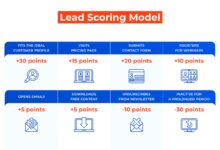
- Assign point values: e.g., +10 for visiting pricing page, +50 for requesting a demo.
Step 3: Set Thresholds for Lead Handoff
Determine the score at which a lead is passed from marketing to sales. This threshold should be based on historical performance.
- Example: Leads scoring 80+ are automatically routed to sales.
- Use negative scoring to penalize inactivity or disengagement.
- Regularly review and adjust thresholds based on conversion data.
Types of B2B Lead Scoring Models
There are several approaches to b2b lead scoring, each with its own strengths and use cases. Choosing the right model depends on your business size, data maturity, and sales cycle complexity.
Manual Lead Scoring
This is the most basic form, where teams manually assign scores based on rules they define.
- Pros: Simple to implement, transparent, and customizable.
- Cons: Time-consuming, prone to human bias, hard to scale.
- Ideal for startups or small teams with limited data infrastructure.
Automated Lead Scoring
Leverages marketing automation platforms like Marketo or HubSpot to score leads in real time.
- Pros: Scalable, consistent, integrates with CRM and email tools.
- Cons: Requires clean data and initial setup effort.
- Best for mid-sized to large organizations with mature marketing tech stacks.
Predictive Lead Scoring
Uses machine learning algorithms to analyze historical data and predict which leads are most likely to convert.
- Pros: Highly accurate, uncovers non-obvious patterns, self-optimizing.
- Cons: Expensive, requires large datasets, less transparent (black box).
- Used by enterprises like Salesforce and Adobe via tools like 6sense or Zylotech.
Integrating B2B Lead Scoring with CRM and Marketing Automation
For b2b lead scoring to be effective, it must be embedded within your existing tech stack. Integration with CRM and marketing automation platforms ensures real-time updates and seamless workflows.
CRM Integration Best Practices
Your Customer Relationship Management (CRM) system is the central hub for all lead data.
- Synchronize lead scores directly in Salesforce, HubSpot CRM, or Microsoft Dynamics.
- Enable sales teams to view score history and key behaviors.
- Trigger alerts when a lead reaches a qualifying score.
Marketing Automation Synergy
Marketing automation tools like Pardot or ActiveCampaign can dynamically update scores based on engagement.
- Automate lead nurturing campaigns based on score ranges.
- Use scoring to personalize email content and timing.
- Pause or re-engage leads based on score decay over time.
“Without CRM integration, lead scoring is just a spreadsheet fantasy.” — Sales Ops Manager, Enterprise Tech Firm
Common Mistakes to Avoid in B2B Lead Scoring
Even well-intentioned b2b lead scoring initiatives can fail due to common pitfalls. Recognizing these early can save time, money, and lost opportunities.
Over-Reliance on Demographic Data
While job titles and company size matter, they don’t tell the whole story. A junior developer might be the actual user influencing a purchase decision.
- Solution: Balance demographic data with behavioral signals.
- Track engagement across multiple stakeholders (buying committees).
- Use intent data from third-party providers like Bombora.
Ignoring Negative Scoring
Not all actions are positive. Leads who unsubscribe, visit the pricing page but don’t convert, or go cold should lose points.
- Implement decay rules: e.g., -5 points per week of inactivity.
- Flag leads for re-engagement campaigns if scores drop below a threshold.
- Prevent sales teams from wasting time on disinterested prospects.
Lack of Continuous Optimization
Markets change. Buyer behavior evolves. Your b2b lead scoring model shouldn’t be static.
- Review scoring rules quarterly with sales feedback.
- A/B test different scoring criteria to see what drives conversions.
- Update models after product launches or market shifts.
Measuring the Success of Your B2B Lead Scoring Strategy
What gets measured gets improved. Tracking the right KPIs ensures your b2b lead scoring is delivering real business value.
Key Performance Indicators (KPIs)
Monitor these metrics to evaluate the health and impact of your scoring system.
- Conversion rate from MQL to SQL: Should increase post-implementation.
- Sales cycle length: Effective scoring shortens time to close.
- Lead-to-customer rate: Higher scores should correlate with higher close rates.
- Sales team satisfaction: Are reps getting better-quality leads?
Using A/B Testing to Refine Scoring Models
Don’t assume your first model is perfect. Test variations to find the optimal scoring logic.
- Split test two scoring rules on similar lead segments.
- Measure which group converts faster or at higher rates.
- Use insights to refine point allocations and thresholds.
Feedback Loops Between Sales and Marketing
The most accurate scoring models are built on continuous feedback.
- Require sales reps to log why a lead was disqualified.
- Hold monthly syncs to discuss scoring accuracy.
- Adjust scoring rules based on real-world outcomes.
What is b2b lead scoring?
B2B lead scoring is a methodology that assigns numerical values to business prospects based on their demographic profile, firmographic data, and engagement behavior. The goal is to identify which leads are most likely to convert into customers, enabling sales teams to prioritize high-value opportunities.
How do you calculate a lead score?
Lead scores are calculated by assigning points for specific attributes (e.g., job title = +20) and behaviors (e.g., downloaded case study = +15). These points are summed, and when a lead reaches a predefined threshold (e.g., 80/100), they are passed to sales. Negative scoring can also be applied for inactivity or disengagement.
What tools are best for b2b lead scoring?
Popular tools include HubSpot, Marketo, Salesforce Pardot, and 6sense. These platforms offer built-in scoring features, CRM integration, and automation capabilities. For advanced needs, AI-powered tools like Zylotech or Infer provide predictive scoring.
How often should you update your lead scoring model?
It’s recommended to review and update your b2b lead scoring model at least every quarter. Market conditions, product changes, and sales feedback can all impact scoring accuracy. Regular optimization ensures the model remains aligned with real-world performance.
Can small businesses benefit from b2b lead scoring?
Absolutely. Even small teams can implement simple scoring rules using spreadsheets or affordable CRM tools. The key is starting small—focus on 2-3 key behaviors and 1-2 demographic factors—then scale as data and processes mature.
B2B lead scoring is not just a tactic—it’s a strategic imperative for modern sales and marketing teams. By systematically evaluating leads based on data, companies can dramatically improve efficiency, shorten sales cycles, and boost revenue. The journey starts with alignment, continues with smart model design, and thrives on continuous optimization. Whether you’re using manual rules or AI-driven predictions, the goal remains the same: turn noise into actionable insight. With the right approach, b2b lead scoring becomes the engine that drives predictable growth.
Further Reading:
